Beginning in 2013, Kore Essentials began working to make and refine some of the industry’s most durable conceal carry and field/range belts. Among its product line, are Kore’s Multicam tactical nylon gun belts, of which come in a variety of buckles and patterns.
The OP Assault Pant by Born Primitive is the company’s solution to provide the tactical community with flexible trousers using high-durability textiles.
Today, the Caiman ballistic helmet offered by Galvion is on its second generation of production, with slight improvements to the suspension and helmet’s hardware over its initial design release. Scoring a total of 21 out […]
The Pelican Protector series provides significant storage and maximum padding, while the 1560 provides an ideal size to support the end-user for a hard day on the range or in the field.
As a base layer, range shirts need to provide adequate sun and skin protection – while still maintaining enough ventilation so as not to overheat the wearer. Scoring a total of 17 points out of an available 25, the Boss Rugby shirt from Velocity Systems did well for its good overall level of durability and function.
The AVS is (debatably) the most load-bearing and popularized plate carrier on the market, which often begs the question of how has a plate carrier, with over 12 years of service, retained […]
Debuted in 2012, Crye Precision released its Adaptive Vest System, or AVS, to offer the military a scalable system that could range from low-profile carrier to full assault configurations. Eventually, the AVS would go on to replace the Modular Body Armor Vest system and become the premiere armor system for military special forces. Sold as individual components, the AVS enables the end-user a broad array of configurations that best suit their mission or individual needs. Because of its longevity and popularity, an extensive aftermarket has also developed around the AVS.
The Rifle and Optics Toolkit by Fix It Sticks offers a compact kit, with some of the most common bits to adjust a multitude of optics and accessories, and includes a calibrated torque driver that can meet the needs of most challenges.
ARPC (Steel 1) May 2, 2026 at 7:30 am – 4:30 pm
Arnold Rifle & Pistol Clubn8343 Metropolitan Blvd, Barnhart, MO 63012, United States
Repeats every first Saturday. Register at: https://practiscore.com/clubs/arnold-rifle-and-pistol-club
MOST - FC Cans Only (Gadsden Sporting Complex) May 30, 2026 at 7:15 am – May 31, 2026 at 3:15 pm
538 MO EE, Iberia, Missouri 65486
Registration fee is $40 Pratiscore at: https://practiscore.com/clubs/missouri-steel-tactical-series/matches
Released in 2022, the Shade Shirt SPF 50+ by Otte Gear provides much of the outdoor functionality from the company’s apparel line, with new fabrics intent on limiting outdoor and sun exposure in the days of fall and winter.
Made from a blend of 88% polyester, 12% spandex the Shade Shirt fabric is designed to provide the wearer UPF 50 sun protection to the upper torso areas, to include the neck and arms. Each cuff includes pass-through thumb ports to extend sleeve protection to the top of the hand as well.
The fabric also includes anti-microbial and moisture wicking patterns to rapidly eliminate sweat and odor.
Made with built-in stretch features, the Shade Shirt also includes a large front breast pocket secured via polymer zipper (to avoid corrosion) for flat or smaller admin items.
The over-sculpted hoodie is designed to enclose a ball cap, hearing protection, or other headwear to protect the overall head.
The Sun Slayer Hoodie is available in Flint Grey (featured), Light Khaki, Mosstone, and POW Vintage and comes in sizes XSmall to 5XL.
Product Evaluation Scores:
Cost – Average (3/5): With its list price of $59.00, the Shade Shirt provides a breathable, flexible material that protects the head, neck, and arms for those experiencing the outdoors in the late summer and fall. In comparison, the Zone Full-Zip Hoodie ($50) from 5.11, the Midweight Basic Hoodie ($50) from Rogue, and the Fallback Shooter Hoodie ($65) from Viktos all illustrate that amid the market of direct comparable the Shade Shirt is appropriately (or of average) priced for the consumer.
Comfort – Good (4/5): From a comfort aspect the Men’s Shade Shirt material had a very smooth and flexible feel on the arms and shoulders, though somewhat tight in the forearms (as per design). This was consistent to the elastic cuff material at the wrist, which kept out and heat was appropriately retained. This material proved further benefit in the cool, damp fall mornings but was easily modified with sleeves rolled up as the day’s heat increased. The breathable and anti-microbial fabric also minimized sweat and helped to keep down odor despite several days of being worn under a plate carrier during drills, and not washed. The only downside is the pattern is clearly designed around the average body type, so those with above the average height may find that their longer arms may not fit as appropriate.
Durability – Average (3/5): Durability wise, the Shade Shirt was made from a blend of polyester and had an appropriate (or average) durability as expected from most outdoor base clothing. There were instances during the evaluation where hook-and-loop (male) material from gear or gloves would pull and fray some of the superficial threading around the cuffs and sleeves, so over long-term wear this could possibly cause further issue. However, during the evaluation, no friction compromised the fabric around the neck (from rifle slings) and torso (from plate carriers). It is recommended that end-users consider using a layered approach with the Shade Shirt, with the shirt as a base layer to provide the best overall use.
Functionality – Good (4/5): Functionally, the Shade Shirt did an excellent job as a base layer to defray early morning chill and moisture. The sleeves could be rolled up when the temperature rose and the body needed more cooling surface. With the UPF 50 sun protection, the hoodie was worn throughout the day and no sunburn was experienced despite continual direct sunlight. The hoodie and high neck fabric had no drawstring and negated any friction from rifle sling or other gear. Other elements like the thumb pass-through cuffs were good during rain or damp mornings to further keep the hands warm, if gloves were not available.
Weight – Good (4/5): At just 10.2 ounces (for the evaluated XL size), the Shade Shirt was very lightweight and served as an ideal base layer for the cooler temperatures of fall or winter. The added hood and long sleeves gave added protection against direct elements over longer periods in the field or range. In contrast, the Zone Full-Zip Hoodie (7.2 ounces) from 5.11, the Midweight Basic Hoodie (8.25 ounces) from Rogue, and the Fallback Shooter Hoodie (12 ounces) from Viktos all illustrate that material/fabric choice can play a decisive factor to overall weight and that the Shade Shirt is as a good light weight amid the market of alternatives for the consumer.
I am reviewing this product as a courtesy to the manufacturer and via High Ground Media, LLC, so that I can evaluate it and provide my honest feedback. I am not bound by any written, verbal, or implied contract to give positive reviews. All views are my own, and based off my personal experience with the product.
The views and opinions expressed on this website are solely those of the author. The views and opinions do not necessarily represent those of the administrative staff, and/or any/all contributors to this site.
Bringing together its adaptation on range accessories, the Bang Box by G-Code Holsters is an effective way to organize, securely store, and transport ammo of varying calibers or other accessories. The Bang Box has supportive line of carrying bags (sold separately) that allows the user to consolidate to two or three Bang Boxes per bag and add to the volume of ammo carried.
The Bang Box was first introduced in 2016 as a means to organize the shooter’s range experience. It provides shooter’s a means to store their ammunition while freeing them of the associated endless cardboard boxes and trash. But the Bang Box’s use isn’t simply limited to ammunition and can be used to store cleaning accessories, aid supplies, and more.
It includes a semi-rigid, kydex base molded to provide a flat surface that prevent slippage with rounded corners for ease of storage. On each side is a nylon loop with plastic strap adjustor (shoulder strap sold separately).
The 500D Cordura lid is secured to the base via a genuine YKK zipper with dual shuttles, and double-line stitching for added strength. The lid includes a field of (female) hook-and-loop that allows for PVC caliber identification tabs (sold separately), morale patches, or name tabs to be attached to the top.
Inside the Bang Box lid is a small storage pouch to store patches, data cards, or other accessories. A supportive band of nylon is stitched inside the top of the kydex base that helps secure and protect the stitching from the contents.
Each Bang Box can store a maximum of the following caliber:
9mm…….300
.40……….200
45 ACP…150
.223……..200
Specifications:
Each Bang Box has the approximate (due to curvature) following dimensions:
Length: 6”
Width: 5”
Height: 3”
The Bang Box is available in a variety of colors and combinations to include Multicam/Tan (featured), OD Green, Woodland, and more.
Product Evaluation Scores:
Cost – Fair (2/5): At $27 per Bang Box, each gives the user a unique way to transport and/or store ammunition in a way that keeps the rounds secure and clutter free. The added benefit is less wasted carboard boxes and plastic/styrofoam shell holders left in range trash bins. It’s an almost added aesthetic bonus that it looks better than almost any other means of taking one’s ammo to the range. The other market alternatives to G-Code’s Bang Box would be MTM ammo flip-top cases ($2-$15/ea.), those ammo/brass bags ($10-$20/ea.), local grocery bags, or your pockets. But by law of averages, most shooters just bring their boxed ammo straight from the store to the range and then discard the trash on site. While more expensive than other methods, the Bang Box gives shooters the ability to have reusable and responsible ammo storage at a fair market price that will benefit themselves, the range, and the environment.
Comfort – Good (4/5): Given the size of the Bang Box, its size fit comfortably in one hand, even when fully loaded with ammo. The YKK zippers moved smoothly with no binding or cross-feeding, while the dual shuttles allowed for a nice 2-way opening and closure. There was a little notable excess material in the lid that could allot for slightly more than the manufacturer’s recommended round capacity, but that varies based on caliber stored. It should be noted not to overpack the Bang Box as to get reliable function of the zipper, and not risk damaging the material/stitching that may result from overstuffing it. The kydex base material provided a comfortable yet rigid container that easily fit inside a bag or pack for a day at the range.
Durability – Excellent (5/5): From a durability aspect, the Bang Box had an excellent level of reinforcement included into its design. Because most of the physical material of the Bang Box’s interior is formed kydex, it made the inside easy to clean and otherwise maintain. It also provided robust abrasion resistance to particular points on ammunition or other angled hard edges. Likewise, the 500D Cordura to the lid also provided a good level of abrasion resistance while still giving some measure of flexibility while storing contents. It should be noted that the stitching lines that bridge the gap between the kydex base and nylon lid have multiple rows (both on exterior and interior) through both materials that ensured a secure hold. The hook-and-loop field also had several parallel lines of reinforcement stitching to keep it attached to the lid.
Functionality – Good (4/5): From a functional aspect, the Bang Box did a good job of doing what was intended—to hold ammunition and other items in a secure means and make them accessible when needed. Really the appeal of the Bang Box is to get the user away from needed ammo boxes that prove wasteful, all while looking good doing so. The ability to get customized hook-and-loop (male) patches (sold separately) that denote stored caliber or other contents grow that functionality to more long-term storage. The size of the Bang Box was also appropriate for the modest shooter for an afternoon at the range, but more serious shooters will need multiple boxes. In essence the storage capacity per Bang Box is fixed and limited by cartridge size. G-Code attempts to address this by offering its 2Fer and 3Fer combo packs (sold separately) which include multiple Bang Boxes, but for those looking for the ability to store larger quantities of ammunition they will need a larger number of Bang Boxes or switch to the more generic military surplus storage cans (or something similar). The premise of the Bang Box is a good design and it could be a consideration to G-Code to think of offering two additional sized variants for those looking to either just store more ammunition or have some dedicated rifle/shotgun calibers.
Weight – Good (4/5): At 9oz. (empty) the Bang Box had enough lightweight materials so as to be insignificant in comparison to its weight when fully loaded with ammo. While that meant that an empty Bang Box was easily transported/stored, a full one definitely had some heft to it (one that was determined by the caliber being stored). The box and reinforcing stitching bore that weight well with no popped threading or strain on the Cordura/kydex materials noted. In comparison, carrying around the multiple carboard boxes and shipping materials is often an unnecessary burden since they are generally discarded after the ammunition is expended. Alternatively, placing the ammunition in a type of MTM flip top only gives the user the security of a plastic snap-lid, and not a fully zippered enclosure. In all, for the weight it has and can hold, the Bang Box does well for what it offers in function and durability.
I am reviewing this product as a courtesy to the manufacturer and via STL Shooting Enthusiasts, so that I can evaluate it and provide my honest feedback. I am not bound by any written, verbal, or implied contract to give positive reviews. All views are my own, and based off my personal experience with the product.
The views and opinions expressed on this website are solely those of the author. The views and opinions do not necessarily represent those of the administrative staff, and/or any/all contributors to this site.
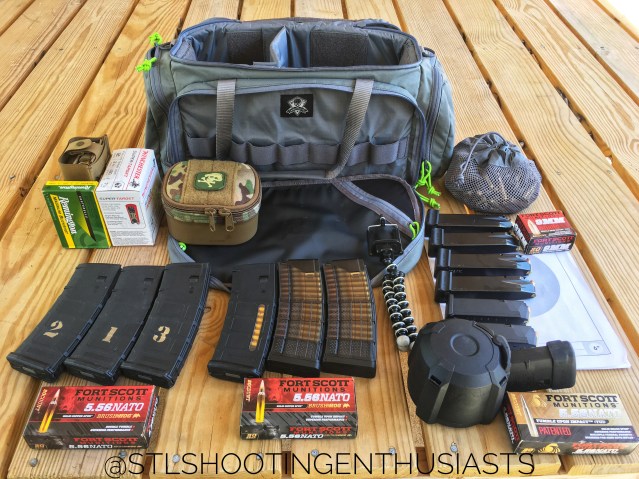
For those spending a day at the range, or working in a little long distance rifle work, the Range Bag by Grey Ghost Gear (GGG) offers a mid-sized bag that will allow you to carry all the daily essentials, protected and compartmentalized for your use.
Exterior
Introduced in late 2018, the Range Bag represents the GGG’s efforts to provide a utility bag in terms of size, while focusing explicitly on supporting a shooter’s needs for a day on the range. The 9” (H) x 20” (L) x 7” (W) Range Bag provides for 20.64 liters of storage and is made from 500D Cordura and is padded on all sides for maximum protection. All pull tabs are a neon green 550 paracord for high visibility.
On the front, the Range Bag has two zipper-secured pockets on the front of an envelope-style pocket that runs nearly the length of the bag and is secured via 1” slide-release buckle.
Both sides of the Range Bag feature an exterior, zipper-secured pouch for accessories, hearing protection, ammo and more.
The rear of the Range Bag has a three-sided zippered pocket on which the opening lays flat for an impromptu workspace. The interior of the pocket (or the workspace) has a vinyl surface with a rare-metal earth magnet stitched into the center of the field to retain smaller metal parts during maintenance. In two corners are smaller zipper-secured pockets for small parts or cleaning supplies. The back side of the pocket (above the workspace) are seven elastic cuffs for storing magazines.
At the top of the Range Bag is a three-sided, zipper secured lid that allows for immediate access into the interior. On either side of the lid are two plastic D-rings (for the shoulder strap) secured via nylon loop and stitched into the interior fabric. Oppositely, two carrying handles are anchored into either side of the opening, and have a rubberized section of material mid-way for improved grip. The removable shoulder strap features plastic hardware and is contoured for comfort. The shoulder strap is padded mid-way with closed-cell foam then wrapped in a rubberized, non-slip material to ensure comfort and control.
The bottom of the Range Bag features two bands of rubberized, textured material to aid in gripping surfaces as well as provide some level of layered protection on the high-contact surface area.
Interior
The main compartment of the Range Bag is accessible from the top, and runs the entire length of the bag. The interior has six large (female) hook-and-loop fields that allow for the removable (male) hook-and-loop divider to be customized based on any need, equipment, or purpose. Also included with the Range Bag is a small mesh bag for collecting spent brass and can be anchored to the interior using the corresponding (male) hook-and-loop panel on one side of the bag.
The GGG Range Bag is available in Grey (featured) and Coyote.
Product Evaluation Scores:
Cost – Average (3/5): With an MSRP of $175.00, the GGG Range Bag is one of the more robust designed personal range bags available. With its size and pockets the bag brings together all the components necessary for a day’s worth of training, or at a local shooting match. Obviously the size, volume of materials, and reinforcement stitching play a factor into the price of the product. The closest market comparator would be First Tactical’s Recoil Range Bag ($99), 5.11’s Tactical Range Bag ($99), and Propper’s Range Bag ($59.99). In each example, the differences in quality reflect the price with more inexpensive bags often sacrificing on design or the type/source of materials. In the case of the Range Bag by GGG, what accounts for the cost increase is a number of additional features that are included into the design that others simply don’t account for. However, much like their competitors, the Range Bag is manufactured overseas and QC/distributed from GGG’s headquarters in Washington. Thus, the price point of the Range Bag is appropriate (or average) for its overall design, and left to the consumer to determine if the cost is affordable.
Comfort – Good (4/5): From a comfort aspect, the padded shoulder strap made bearing the weight of a loaded Range Bag comfortable for short distances. It’s non-slip material also made sure that the weight didn’t pull the shoulder strap over or down. Similarly, the non-slip rubberized material on the handles felt comfortable in the hand, although it would have been a nice improvement had there been a cuff to bind both handles together when the bag was being carried. Otherwise when loaded, the bag felt evenly distributed and secure. All the genuine YKK zippers moved smoothly and did not bind. Moreover, the paracord pull tabs provided a good anchoring point when moving the zipper shuttle around the openings.
Durability – Good (4/5): A lot of attention has been paid to reinforcement of the Range Bag; with bartack stitching that anchored the carrying handles and shoulder strap loops, to box/X-pattern reinforcement stitching on the hook-and-loop fields on the interior. While most YKK zippers showed double-line stitching, the divider and interior liner had a single, continuous stitch line showing that most of the durability of the Range Bag’s design went into ensuring integrity of compartments and high-stress contact points. The 500D Cordura exterior also held up well against abrasion and hard-angle contact points. As often the case, more inexpensive range bags are intended to only carry a single pistol and limited ammunition. Anything more risks compromising the stitching. But with GGG’s Range Bag, we were able to test its load-bearing capacity by using multiple loaded magazines for both rifle and pistol (with range accessories) that far exceeded other competitor’s ability to carry. The only minimal point of improvement for durability would be for GGG to swap out the plastic hardware to the shoulder strap and anchoring points with metal for improved strength/durability.
Functionality – Excellent (5/5): Functionally, the Range Bag has a number of features that set it apart from its noted competitors. From the integrated workspace with rare-earth magnet (that held in springs and pins), to the innumerable three-sided pockets that opened fully for shot timers, ear pro, pasters and more. The internal divider proved easily customized to account for a variety of different sized contents. Even the YKK zippers were the weatherized type to prevent moisture penetration along the zipper line. But two big features stood out as the most prominent for its design; the rubberized bottom of the Range Bag and the magazine storage capacity. On the bottom of the exterior are two bands of non-slip rubberized material that help reinforce the bottom of the bag that will experience the most abrasion, but also limited moisture penetration should you place the bag on a wet surface. It would have been an improvement had the entire bottom been covered, but still a nice feature to see that other vendors often don’t consider. Elsewhere and throughout the bag, there was also the ability to secure 13 double-stack pistol magazines (seven on the exterior and three on each side of the internal divider). This validates that the Range Bag was designed from the beginning to carry more than the usual single pistol capacity. The only notable element for improvement to future designs for GGG, would be to use an offsetting, high-visibility interior lining as the bottom of the main storage compartment proved to be very deep and difficult to see the bottom of for small parts or tools.
Weight – Excellent (5/5): For its weight of 2.10 pounds (empty) the Range Bag by GGG proved to be very lightweight thanks in part to its 500D Cordura material and choice of hardware. With its capacity to add enough contents that dramatically increased the carried weight, at no point during evaluation did the bag show sign of strain or failure. In comparison, the ranges bags by First Tactical (4.4 pounds), 5.11 (6.2 pounds), and Propper (3.55 pounds) were similar in size and offered similar features that would be of benefit to civilian shooters (gun mat, magazine loops, etc.). The weight differential also reflected the use of polyester nylon in some market competitors v. true Cordura nylon. For those who want a dedicated daily range bag to accommodate all the necessities, then they would be well suited to consider the design offered by Grey Ghost Gear.
I am reviewing this product as a courtesy to the manufacturer and via STL Shooting Enthusiasts, so that I can evaluate it and provide my honest feedback. I am not bound by any written, verbal, or implied contract to give positive reviews. All views are my own, and based off my personal experience with the product.
The views and opinions expressed on this website are solely those of the author. The views and opinions do not necessarily represent those of the administrative staff, and/or any/all contributors to this site.


 I am reviewing this product as a courtesy to the manufacturer and via STL Shooting Enthusiasts, so that I can evaluate it and provide my honest feedback. I am not bound by any written, verbal, or implied contract to give positive reviews. All views are my own, and based off my personal experience with the product.


