


I recently had the opportunity to buy a Sig Romeo 5 as a potential Red Dot Sight (RDS) to add into my rotation. But I wanted to see if the optic was worth the hype, or if indeed cheap is crap. While I already own Trijicons, Aimpoints, and a C-More, the optics market has moved in the last several years to diversify itself while offering lower price points (sometimes for good and other times not so much). What I found in my initial fielding was surprising, but also reaffirmed where the Romeo 5 fits within the Sig lineup.
Disclaimer:
While there are plenty of “torture” tests on YouTube for the Romeo 5, this review will not be that. I’m not going to shoot it with a shotgun, drop it from a cherry picker four stories up, or freeze it in a block of ice. What this review process will be is an unbiased (initial) review of the optic. Through the course of the following year I will put it through a series of AR challenges intended to mimic what most shooters would use it for. At the end of the trial period I will offer my closing impressions and decision on keeping it, moving it down to my PCC, or donating it.
Background


The Romeo 5 was first introduced as a 1x20mm RDS and part of Sig’s larger Romeo line-up back in 2016. By 2018, the Romeo 5 was “upgraded” to include a “Don’t Tread On Me” logo, but the features remained the same. Both models have an MSRP at $179 on Sig’s website, but I got mine at Academy Sports for $150. Sig offers their “Infinite Guarantee” with the Romeo 5 that covers all parts of the optic.
The Sig Romeo 5 features:
- Motion Activated Illumination (MOTAC) – shutting down the optic when not in use and instantly activates the system when it senses the slightest vibration or movement. This feature extends the battery life to reportedly 40,000+ hours
- Spectracoat – Described as a highly efficient, ultra-wide broadband, anti-reflection lens coating that reduce surface reflections to extremely low levels across the entire visible spectrum providing superior light transmission
- Stealth ID – Design features inspired by our legendary firearms; trapezoidal surfacing that breaks up the shape and visibility of the optic
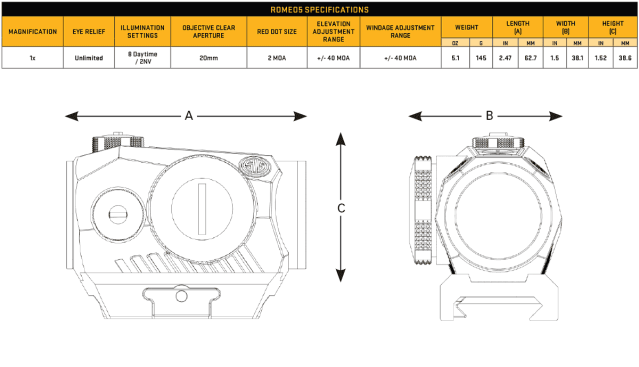
Getting into the optic:

- Integrated M1913 Picatinny mounting system
- Waterproof up to 1m and fogproof
- Box includes one CR2032 battery, one low-riser mount and one co-witness (1.41″) mount

Zero Day
To start off this review, I felt zeroing the Romeo 5 on my 10.5″ AR pistol would be a good place to begin with. Right out of the box the RDS was on the co-witness mount, and the provided star hex key made mounting it on my AR easy. Installation of the CR2032 battery on the side-mounted compartment was easy, and the rubberized spacer on the battery cap provided a nice watertight seal. Aside from that, function of the optic is pretty self-explanatory. Press any (+) (-) button for three seconds to activate, and from there you are ready to go. The 2MOA dot is nice and bright by the 6th or 7th setting, at 8 it had a lot of flare inside the tube.
Using three round strings from seven yards, I began testing to see where point of aim and point of impact would be. Some adjustments were required but eventually I got on target. An added design feature is the adjustment caps have a small notch on the top of them that can be used to help turn the dial in any direction in lieu of a screwdriver or coin. Overall I was pleased that the groupings were all consistent and small.
Target: red-dot-25yd-mod1_1-(ar-15)
After that, I moved back to the 25yd line and used a 25yd zero target that also has an offset mark that allows you to zero out to 300yds. Here I found the smaller increments of the Romeo’s elevation and windage dials made moving in small increments a little difficult. EIther I would shoot over and have to go back in count, or make several small adjustments to ensure proper movement to the point of aim. All in all I eventually found my 25yd zero and proceeded to use the rest of my 500 rounds for light carbine drills. The goal here wasn’t to abuse or push the optic on its first run, but rather get a feel for it and see what it offers. I did test out the MOTAC by letting the rifle sit undisturbed on a table and after several minutes it powered down. The vibration sensor that obviously controls the MOTAC feature is extremely sensitive as I just had to move the rifle slightly for it to turn back on. This feature could be useful if you opt to leave the optic on during long periods of storage (such as in a safe), but if you left the optic on in a car that was moving the MOTAC would likely just stay continually on. As times goes on I’ll be able to give more in-depth impressions on how the Romeo 5 is holding up.


So far here are my initial impressions:
- Pro: The housing of the Romeo 5 is nice, angular and about the same in size as a T2 and doesn’t have the “soda straw” view of the Aimpoint PRO
- Pro: It sits on a one-piece aluminium riser so it was very sturdy on the rifle and didn’t rattle loose
- Con: Not impressed with the optic lens cover, a type of bikini-cap thing that is held together by two thin strips of plastic – I anticipate these will be the first casualty more than anything with the optic
- Con: The diameter of the lens closest to the shooter is about 15% smaller than that of an Aimpoint PRO (my control in this entire process) and limits the field of view when looking through the Romeo 5 – To offset this disparity I brought the RDS about 1.5″ closer on the rail to the eye to approximate the differences in fields of view
Overall I am initially impressed with the Sig Romeo 5 for its design and packaging, as well as setup and ease in zeroing. Sig initially jumped into the optics market in 2016 as an effort to diversify its branding, and so far the Romeo 5 looks like it will be a solid contender for its modest price point. I look forward to getting into more aggressive use and see how it holds up.


